
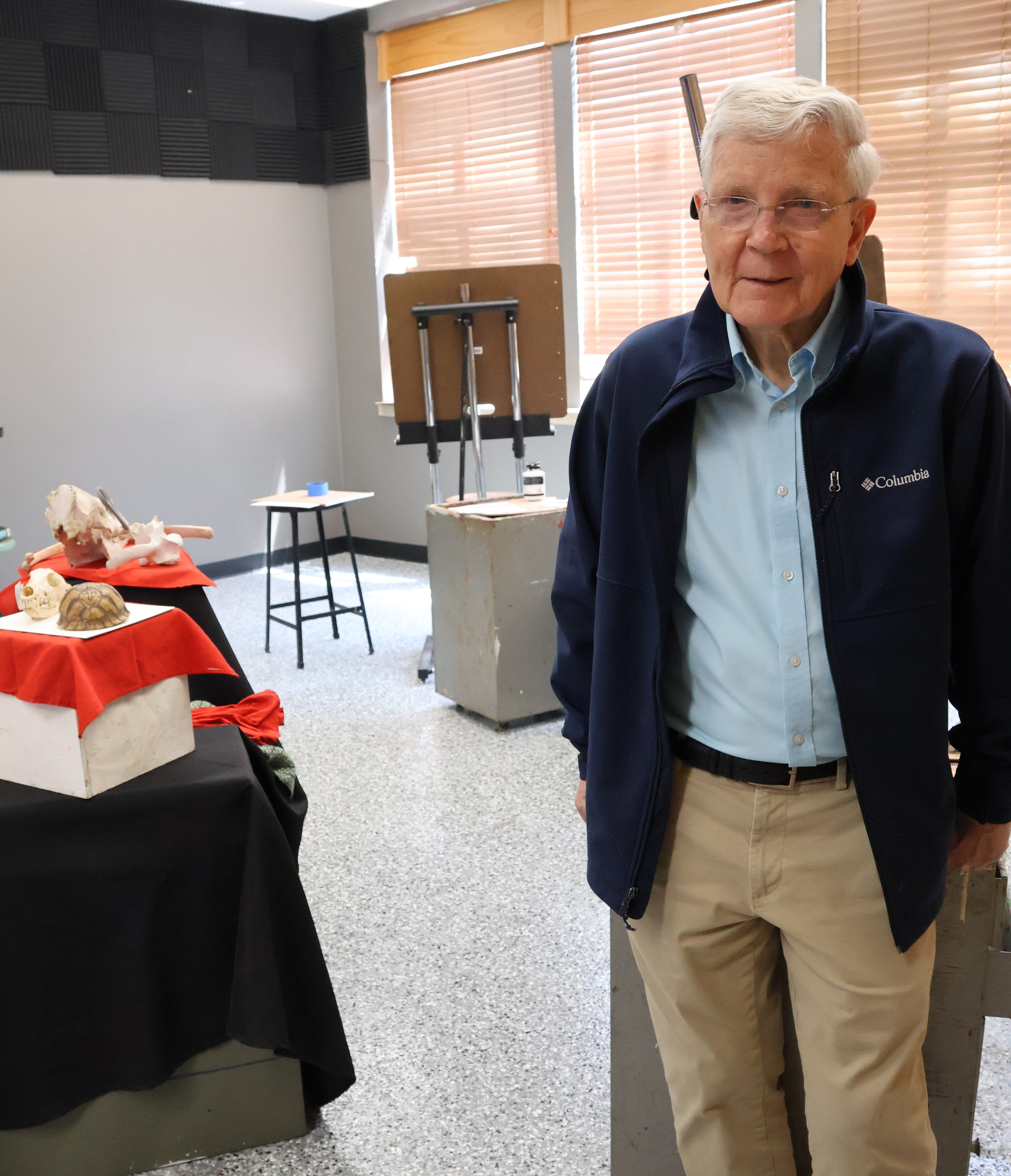
Clem Allison stands in the two-dimensional studio art laboratory.
GREENEVILLE– Whenartstudents walk into their classrooms this year atTusculum University, they will enjoy spacious rooms and beneficial natural lighting that will strengthen their academic experience.
A $10,000 gift from Clem Allison, professor of art emeritus at the university, enabled Tusculum to greatly expand working space for students in the three-dimensional sculpture laboratory. The funds also enabled the university to relocate the two-dimensional studio art laboratory to a larger space with special flooring and storage facilities to support teaching and learning.
The 2-D lab is named after Allison, whose relationship with Tusculum now stands at 60 years, in recognition of his leadership of the art program, his teaching for 34 years at the university and his ongoing financial backing of the university since he retired in 2000. He continues to paint and draw and has contributed pieces periodically to Tusculum art shows.
“We are extremely grateful to Clem for this donation, which will greatly bolster the hands-on learning of our art students,” said David Cook, provost and vice president of academic affairs. “It warms my heart that our students will be able to further develop their abilities in an enhanced classroom environment. That investment will help us draw even more students to our outstanding art program, which prepares them for a career in that field or gives them additional skills that can be applied to other professions.”
Allison was pleased with the outcome of his donation. He said the upgraded facilities provide the impetus for the art program to flourish.
“If you want to have students who will major in art or take courses in that subject, you need to have the facilities to encourage them to do that,” he said. “That was my incentive for this gift, and I’m very happy with the way this project turned out. I am glad that the students have access to improved studios for sure. This gives the program sustained life with excellent facilities.”
The new spaces are a hit with the students as well. Kyler Hayes, a sophomore who is pursuing a degree in visual communications, utilizes the 2-D lab and is impressed with the lighting.
“The lighting plays a big part when you’re trying to paint and mix your colors,” Hayes said. “With bad lighting you don’t know how good your paint or your work really is. The corkboard in the 2-D lab is a really good way for us to display our work. We have a lot of space to work and move and be creative. It really helps the student, especially me.”
The laboratories are located in Annie Hogan Byrd Fine Arts Center. In addition to the laboratories, the building houses the Clem Allison Gallery, where Tusculum holds a variety of exhibits under the direction of Benjamin Conley, assistant professor of art. Annie Hogan Byrd is also home to the digital media and graphic arts academic programs as well as Behan Arena Theater and the Marilyn duBrisk Theatre, where the university holds theater, band and chorus performances.
Allison shared his interest in donating the funds for the enhanced space during a TusculumCenter for the Artsgala. The university’s Facilities Management Department completed the work. Students were able to use both spaces toward the end of the spring semester, but now they will have it for a full academic year.
Conley said the additional space for the 3-D lab gives students the opportunity to work on large-scale projects. He wants to tackle works that require the use of power tools and other equipment in the making of art.
“Having this amount of space allows students to really expand on their art making, both in scale and scope,” Conley said. “It also allows us to host a location where ceramics and sculpture can happen in a rotation. I will have the space now to put the sculpture equipment in storage during the semester when we teach ceramics instead. That will be very easy to accomplish with this new space.”
The large amount of instructional and work space in this area is appealing to Allison.
“If you want to expand the number of students you are serving in the program, then you need the space for it,” he said. “We have accomplished that with this project. This laboratory is well-lighted, and the new sink that was installed is fantastic.”
The 2-D laboratory features a garage epoxy floor with rubber specks in it, which increases the ease and efficiency with which charcoal, pastel and various paints can be cleaned. The room also features a corkboard for student work to be posted and Conley and others to critique the art. It is also a spot where Conley can place instructional material for students to review. Additionally, the facilities crew placed a track lighting system so students can take high-quality photos of their work, which is an important part of that academic program.
Tusculum installed a new ventilation system, which increases the opportunities for students to use oil paint. The room also has abundant windows, which will be a major benefit for students taking a drawing class. Additionally, this laboratory contains plenty of storage space to take care of a wide array of needs for easels, canvases and drawing and painting materials, with easy access for Conley and the students.
“I would be confident to say this space rivals any other 2-D space at a higher education institution in the region,” Conley said. “I would consider this space state-of-the-art, especially with the ventilation system, the track lights and the corkboard. It’s a really exceptional spot for painting and drawing.”
Allison loves all of the elements of the new room, but he is particularly enamored with the large amount of light in the laboratory and the overall amount of space. He views the laboratory as a professional environment for the students and the professor to complete their work.
As he reflects on his decades of involvement with Tusculum, including repeated gifts to the university, Allison said there are reasons he maintains the relationship.
“I have close ties to the university,” he said. “I have stayed good friends with the people who have overseen the art program since I retired. It was my home for all those years, and then the university named the gallery after me. So, I have felt I have a personal attachment to Tusculum. I have just wanted to help.”
Tiffany Greer, vice president ofinstitutional advancement, said donors such as Allison are important to driving success at the university.
“When individuals, companies and organizations make gifts to the university, they are contributing to the development of next generation of career-ready professionals Tusculum produces,” she said. “They are enriching the lives of our students by investing in their futures and enhancing the quality of life in the communities where our students serve during their careers. We are also grateful to our donors because their gifts strengthen our academic offerings and make it possible for many of our students to stay in school and graduate.”
To donate to the university, please visitwww.tusculum.edu/giving. To apply for admission, visithttps://site.tusculum.edu/apply-visit/apply/. More information about the higher education institution is available atwww.tusculum.edu.