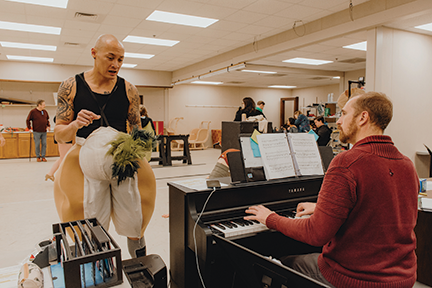
Sean Campos works on 'The Grinch' with Dishon Smith
At the beginning of every musical at Barter Theatre, the lights go down, the first notes fill the room, and just like that, you’re transported somewhere else entirely. It happens every time, so seamlessly that you never stop to wonder how. You notice the costumes, the actors, the way a song catches in your chest at exactly the right moment.
What you don’t notice is the person who spent weeks making sure every note, every harmony and every musical cue lands exactly where it should. That person is Dishon Smith, Barter’s resident music director. As music director, Smith is responsible for all things musical in a production: teaching the cast their music, hiring and coordinating the band, producing the recorded tracks that fill out Barter’s sound and maintaining the quality of the music from the first rehearsal all the way through to closing night. It is a role that shapes the entire feel of a show, and one that found him through a path he never planned.
Smith grew up with two loves: piano and theater. He pursued acting into college before realizing it wasn’t the right fit and drifted back towards music — but theater never fully let him go. A last-minute call from his high school drama teacher, who needed a piano player for “You’re a Good Man, Charlie Brown,” put him in a rehearsal room in an entirely new way.
He made mistakes, learned from them and walked away with a realization that would quietly redirect the rest of his career. “That was the first moment I [realized] I could still be really involved in theater and not be on stage.” Two passions that once seemed separate had found a way to meet in the middle.
After graduating with an undergraduate degree in piano performance and a master’s degree in piano pedagogy, Smith was able to turn that earlier realization into something real. He developed his skills in music direction over several years in community theater, gradually taking on more challenging and complex scores.
When a recommendation from a fellow musician landed him a keyboard position in Barter’s 2013 production of “Kiss Me, Kate,” one show led to another, and then another. By 2018, Barter brought him on as associate music director, and he’s been there ever since.
What the job looks like day to day is more hands-on than most audiences realize. Before rehearsals even begin, Smith is deep in preparation, building detailed spreadsheets that map every song to every voice, accounting for costume changes that pull ensemble members offstage and creative decisions still being worked out by the director and choreographer. He figures out which musicians to hire live and which parts he’ll produce himself as carefully recorded tracks that are custom-built for each production.
Then there’s the puzzle-solving that happens between each song. Scene change music is written for the original Broadway score, meaning it is timed to fit that specific production. When Barter takes on a show, the set, staging and pacing are often all completely different from their original conception. Transitions that once needed two minutes of music might need thirty seconds, or none at all. “Sometimes we need more music, sometimes a lot less ... because we figured out a way to slam into the next scene a lot faster,” he says. “It’s a puzzle, and I love doing that.”
One of the most unique aspects of working with a company like Barter is having a deep understanding of each actor’s musical abilities. With Barter’s resident acting company, Smith has built a history. He knows who can move between soprano and alto without hesitation, or who he can rely on to shift from tenor to bass depending on what a number needs. That familiarity saves time and, more than that, deepens the work. “It saves a lot of time and a lot of emails,” he says with a laugh, though what he’s describing is something more like trust built over seasons and seasons of careful collaboration.
What that collaboration looks like depends on who’s in the room. Most of Barter’s larger casts are a mix of resident company members and guest artists, and each requires something different from Smith. A guest joining the company means demo reels and conversations about vocal range; the early work of learning a voice. With the resident company, that work is already done. ”Guys & Dolls,” opening this summer with a cast drawn heavily from the resident company, puts both kinds of relationships in the spotlight at once. With its sprawling ensemble and a score full of big, layered harmonies, it’s exactly the kind of show that rewards the history Smith has spent years building here.
Theater is a collaborative art form, and at Barter, that spirit runs deeper than most. It is present long before opening night, in the careful preparation that happens before a single rehearsal begins, and it carries through years of trust that accumulate between artists who have chosen to build something lasting together. At the center of that equation is Dishon Smith, whose work has become as much a part of Barter’s identity as the stage they all call home.